
Laravel and Blockchain: Building Secure, Transparent Transaction Systems
In today’s digital landscape, security and trust are no longer optional—they’re fundamental. As applications increasingly handle sensitive financial and transactional data, developers are exploring ways to make systems more tamper-proof and transparent. This is where blockchain technology comes in.
Laravel, one of the most popular PHP frameworks, provides a robust foundation for building modern web applications. When combined with blockchain, it opens up powerful possibilities for secure, decentralized transaction handling.
Let’s explore how Laravel and blockchain can work together—and how you can start integrating them.
Why Combine Laravel with Blockchain?
Laravel excels at:
- Clean architecture (MVC)
- API development
- Authentication and authorization
- Database management
Blockchain adds:
- Immutability (data cannot be altered)
- Transparency (transactions are verifiable)
- Decentralization (no single point of failure)
Together, they enable:
- Secure financial transactions
- Fraud-resistant systems
- Transparent audit trails
- Trustless interactions (no need for intermediaries)
Common Use Cases
Here are some real-world applications of Laravel + blockchain:
1. Payment Systems
Use blockchain (e.g., Ethereum) to process payments securely while Laravel manages business logic and UI.
2. Supply Chain Tracking
Store transaction records on-chain while Laravel dashboards visualize the data.
3. Digital Identity Verification
Blockchain stores identity hashes; Laravel handles user flows and access control.
4. Smart Contract Integration
Laravel apps can trigger and interact with smart contracts for automated workflows.
Architecture Overview
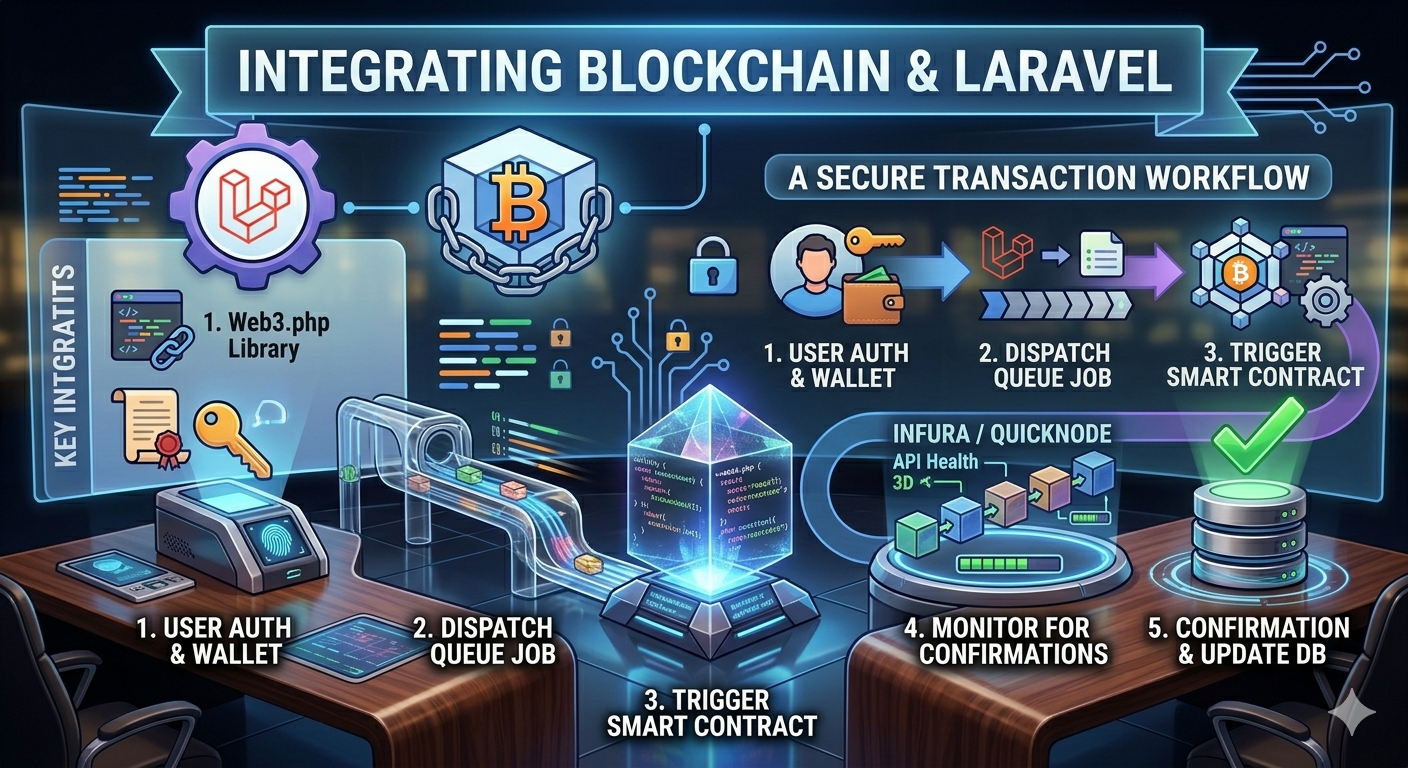
A typical Laravel + blockchain system looks like this:

Laravel acts as the bridge between users and the blockchain.
Tools & Technologies
To integrate blockchain with Laravel, you’ll commonly use:
- Web3.php – PHP library for Ethereum interaction
- Guzzle HTTP Client – for API calls to blockchain nodes
- Infura / Alchemy – blockchain node providers
- Solidity – for writing smart contracts
- Ganache – local blockchain for testing
Step-by-Step Integration
Step 1: Set Up Laravel Project

Step 2: Install Web3 Library

Step 3: Connect to Ethereum Network

Step 4: Interact with Smart Contract

Step 5: Sending Transactions

Security Best Practices
When working with blockchain in Laravel, security is critical:
Protect Private Keys
- Never store keys in plain text
- Use .env or secure vault services
Validate Transactions
- Always verify inputs before sending transactions
- Use backend validation layers
Use Test Networks First
- Try Goerli, Sepolia, or Ganache before mainnet
Implement Rate Limiting
- Prevent abuse of blockchain endpoints
Audit Smart Contracts
- Bugs in contracts are irreversible
Challenges to Consider
While powerful, blockchain integration comes with trade-offs:
| Challenge | Description |
|---|---|
| Cost (Gas Fees) | Transactions can be expensive |
| Speed | Blockchain confirmations take time |
| Complexity | Smart contracts require expertise |
| Scalability | Not ideal for high-frequency operations |
Best Practices for Laravel + Blockchain Apps
- Use blockchain only for critical data, not everything
- Store large data off-chain (e.g., AWS, IPFS)
- Cache blockchain responses for performance
- Use queues (Laravel Queues) for async processing
- Log all transactions for traceability
Future of Laravel + Blockchain
As Web3 adoption grows, Laravel developers can play a key role by:
- Building decentralized applications (dApps)
- Integrating crypto payments into traditional apps
- Creating hybrid Web2 + Web3 platforms
Laravel’s simplicity + blockchain’s trust model = next-gen secure applications.
Conclusion
Integrating blockchain with Laravel allows developers to build systems that are not only functional but also secure, transparent, and future-ready.
While the learning curve can be steep, the payoff is significant—especially for applications where trust and integrity are critical.
If you’re a Laravel developer, now is the perfect time to explore blockchain and start building beyond traditional boundaries.